Furniture that moves, and furniture that stays
A bed frame stands against a wall and does not move for years. That is fine. Beds are the fixed points in a home. But a living room piece has to be ready to shift. A sectional that hugs three walls on Tuesday can open into a guest bed on Friday. A chaise that starts beside the fireplace might end up under the window when the light moves. We think of these pieces as furniture that moves, and we build them so that moving them does not feel like a compromise.
The moving often starts before the piece is even in the room. A sofa has to fit through a door, turn a corner, and settle in, and still work if the room gets rearranged a year later. That is why we put so much thought into module weights, the way a sleeper mechanism folds flat, and the hardware that locks sections together. But those are details for later sections. The core idea is simpler: a living room changes shape all the time, and the furniture in it should be able to change with it.
Not all of our living room pieces are modular. A power recliner stays in one spot, yet it moves where you need it to, tilting back for a film, lifting forward to help you stand. A nursery rocker glides through hours of feeding and settling, moving without leaving its footprint. Even a stationary accent chair moves the character of a room by bringing a new color and a new texture. So when we say furniture that moves, we mean it two ways: pieces that physically rearrange, and pieces that shift to suit the shape of a day.
Widths that fit through a door
A sofa that is wider than your door will not enter your home. We say this plainly because we have seen it happen. A standard interior door measures about 30 inches across. Remove the door from its hinges and you gain a little less than an inch. The widest sofa we make is 153″ inches wide.
It will not go through that door in one piece. The math is not complicated, but it is easy to ignore when you are looking at a photograph. We ask you to measure the doorway, the hallway that leads to it, and any corner the piece must turn, before you order.
| Width | What it is | Pieces | From |
|---|---|---|---|
| 0″ to 80″ | A loveseat or a two-seater | 6 | $206.99 |
| 80″ to 110″ | A three-seater, most sofa beds | 11 | $399.99 |
| 110″ to 140″ | A sectional for a family room | 7 | $539.99 |
| 140″ to 153″ | A U-shape that fills a wall | 5 | $699.99 |
We design our modular sectionals so this problem mostly goes away. A cloud sectional arrives as separate seats, ottomans and corner modules. The largest module is the seat box, and we keep it under the width of a common door. You carry the pieces through, stack them in the room, and lock them together. A fixed sofa is different. For those, we publish the width and the depth and the height.
Often a sofa will pass through a doorway on its side, if the depth is less than the door opening. We list all three numbers so you can check. We also note the height of the legs, because some are removable and some are not. If you have a tight stairwell or a sharp turn at the top of a landing, the diagonal matters. We cannot measure your home, but we can give you the numbers that let you do it.
The doorway is the first filter. After that comes the room itself. A sofa that fits through the door but fills the whole wall will make a small room feel smaller. We give you the footprint of every piece so you can tape it out on the floor before it arrives.
A few minutes with painter's tape will tell you more than any photograph. You will see where the walkway narrows, where the morning light hits the arm, and whether the recliner clears the coffee table when it is open. We want you to keep the sofa. The easiest way to keep it is to know it fits before the truck pulls up.
Cloud sectionals: the modules and the layouts
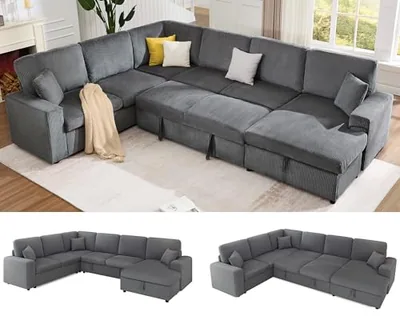
A cloud sectional is not a sofa you bolt together once and leave in place. We build it from a small set of modules that connect with brackets under the seat, and you can rearrange them in an afternoon. The core pieces are an armless chair, a corner, an ottoman, and a chaise. You clip them together in any order, and the layout you make on a Tuesday can be completely different by Saturday. We keep the connections simple and the modules light enough that one person can shift them across a room.
From those few shapes you can build a loveseat, an L-shaped sectional, a U that wraps a coffee table, or a long wall of seating that runs the length of a living room. You can add a chaise at one end, or use an ottoman as a freestanding seat that becomes part of the frame when you need more room. The pieces do not lock you into a single arrangement. If you rearrange the furniture twice a year, the cloud sectional will follow you.
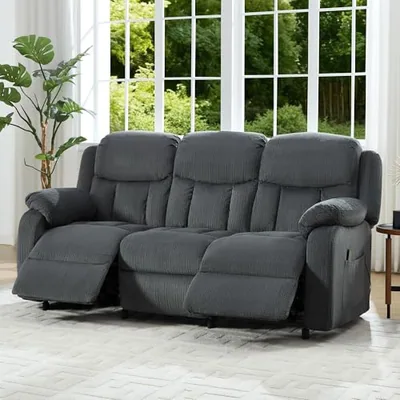
We sit on every sample before we approve a fabric, because velvet, linen, boucle and corduroy each feel different under a hand and under a lamp. The cloud modules are upholstered in the same fabrics we use on our wingback beds, and we choose the cushion fill to hold its shape through a long evening without a fluff.
That said, a cloud sectional is not a sleeper sofa. It does not pull out into a bed, and it is not a power recliner. Those are separate pieces, and we talk about them in other sections. What it is, is a set of blocks that let a room change shape at the pace of your household. We think that is enough.
Sleeper sofas, and who sleeps on them
We make a few sleeper sofas, and we keep the range small because we design each one around a single question: who will sleep on this, and for how long? A sofa that folds out into a bed looks like any other piece during the day. The same velvet, linen and boucle we cut for our stationary sofas goes onto these frames, so you do not have to stare at a pull‑handle until you need it.
The person who sleeps here is a guest for two or three nights. A child on a Saturday sleepover. A friend who missed the last train and needs a flat surface until morning, nothing more. We do not build these for a permanent bed in a studio apartment, and we say so plainly. The folding mattress inside a sleeper sofa is thin by necessity. It cannot give you the support of a full platform bed with a real mattress, and it will feel firmer than the sofa cushions you sit on by day.
If you need a bed that someone will sleep on every night, this is not the right piece. One of our upholstered or solid wood platform beds, with a proper mattress and no box spring required, will do the job far better. But when the guest room is also the living room, a sleeper gives you a seat for six evenings and a bed for the seventh. It opens in under a minute, and we test the mechanism until it works without catching, because the person pulling it out is usually already tired.
Chaise lounges and double chaises
A chaise lounge asks you to put your feet up and lean back, and not much else. It is not a seat for working at a laptop or eating dinner. It is a piece for reading, for a quiet phone call, for a child who wants to lie next to a parent on a Sunday afternoon. We make two kinds: the single chaise, which is a long seat for one person, and the double chaise, which is wide enough for two to sit side by side or for one to stretch out fully.
Both have the tall back and the low foot, the shape that makes a chaise what it is. Our backrests angle just enough to take the weight off your lower spine without tipping your head forward, and the foot end is padded the same way as the seat. You do not feel a hard edge under your ankles.
A single chaise works in a corner of a bedroom, in a nursery, or in a living room where you have an empty wall and no room for a full sofa. A double chaise needs more floor space and does not look right pushed against a wall. It is meant to float in a room, with air on three sides.
If your room is narrow or you need seating that faces a television straight on, a chaise is the wrong piece. We say that plainly because we have seen people try to make it work and regret it. A chaise faces sideways to the room, not forward. You lie on it, you do not sit.
We offer chaises in a handful of our living room fabrics: a soft chenille, a flatweave linen blend, and a performance velvet that wipes clean with a damp cloth. The covers are sewn to stay put during the kind of shifting that happens when you turn over to find a better position. All of them meet the federal smolder standard, the same as every upholstered piece we make.
The frame underneath is the same engineered wood we use in our sofas, with a reinforced center rail, and the legs are solid wood with a finish that matches the feet of our sofas. You can pair a chaise with a sectional or use it alone. It does not turn into a bed, and it does not have storage inside it. That is not what it is for. What it is for is a long, quiet sit with your feet up, and we think that is enough.
Power against manual reclining
We build both power and manual recliners, and we have learned that the right one depends less on the room and more on the person who will sit in it every day. A manual recliner asks you to lean back and push against the arms or pull a lever, and the mechanism responds with a simple mechanical arc.
It does not need a wall outlet, so you can float it in the middle of a room or tuck it into a corner with no cord to route. It is lighter, too, which matters if you rearrange the living room twice a year or move between apartments. The tradeoff is that you commit to the recline in one motion. You cannot pause partway unless the chair happens to catch at a middle notch, and most do not.
| Piece | Power | USB or charging | Price |
|---|---|---|---|
| 78 in Power Reclining Sofa, Electric Recliner Couch, Gray | Power | No | $499.99 |
| 77 in Power Reclining Sofa, Recliner Couch for Living Room, Beige | Power | No | $599.99 |
| Power Rocking Nursery Chair, Swivel Recliner, USB, Gray | Power | Yes | $379.99 |
| Recliner Chairs for Adults, Fabric Manual Reclining Chair, Brown | Manual | No | $259.99 |
| Power Rocking Nursery Chair, Swivel Recliner, USB, Cream | Power | Yes | $349.99 |
| Power Recliner Nursery Chair, Rocking, Corduroy White | Power | Yes | $399.99 |
| 128 inch Power Reclining Sofa, Electric Recliner Sofa, Gray | Power | Yes | $2999.99 |
| Power Rocking Nursery Chair, Swivel Recliner, USB, White | Power | Yes | $419.99 |
A power recliner gives you that middle ground. A quiet motor drives the footrest and the backrest separately, and you stop the motion wherever your body feels right. You hold a button instead of pulling a handle, so your hands stay still and the movement is smooth enough not to wake a sleeping child on your chest.
Every power sofa we design needs to sit within reach of a standard outlet, and the cord is visible from the side, so we plan for that in the layout. The frame is heavier than a manual frame because the motor and the steel lift mechanism add weight. That extra mass is not a flaw, but it does mean you will want help getting it through a doorway.
We spec the same high density foam and the same fabric choices on both types, so the difference is purely the mechanism and the presence of a motor. A manual recliner suits someone who wants a straightforward chair that will work in any room, no outlet required. A power recliner suits someone who wants fine control over their position, perhaps because they nap in the chair or because joint pain makes a lever hard to reach. Our widest power sofa stretches to 153″ across, and at that size the motor does the work that a manual mechanism would struggle to balance evenly.
Neither version is better in the abstract. We have watched people test both in the same afternoon and choose opposite sides. The manual chair asks for a little effort and gives back simplicity. The power chair asks for a nearby outlet and gives back a quiet, adjustable rest. Pick the one that fits how you actually sit, not the one that sounds more modern.
The nursery rocker, and the hours it is used
A nursery rocker gets used in a way few other chairs do. It works at two in the morning, with a baby who will not settle. It works again at noon for a bottle, and again at bedtime with a book across your lap. When we build one, we think about those hours more than we think about how it looks in a photo. The seat has to let you stand up without waking the child. The back has to hold a tired adult, not just a sleeping one.
The power version helps because at three in the morning you may have one hand free and a baby on the other arm. A small control lets you ease the back into place without shifting your weight. We keep the motion gentle. It does not change shape the way a sectional does. It changes shape only enough to take the weight off your back. It is not a home theater seat and it is not a sleeper.
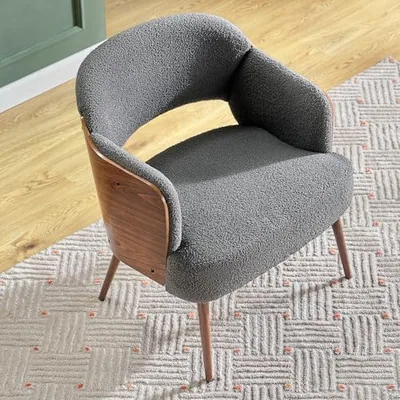
We sit on every sample before we approve a fabric. On a rocker, the cover has to feel calm against a bare arm and still take a wipe at the seams. We keep the shapes simple and the colors limited, so the chair reads as part of the room, not the loudest thing in it. The chair does not fold and does not turn into a bed. It is for short rest, not for the whole night. We say that plainly because it helps you skip what you do not need.
Place it where you can brace your feet and reach a small table. It wants a lamp that stays dim and a clear path from the door. If the room is tight, give it enough floor behind it so the rocker can move without touching the wall. We build the rocker for the hours nobody photographs. That is the whole point of it.
The smolder standard behind every cover
Every upholstered piece of furniture we make that ships into the United States carries a permanent label. The label does not talk about color or pile direction or thread count. It states compliance with 16 CFR Part 1640, the federal smolder standard. That is the single law a sofa must meet before it can cross a state line, and meeting it is not optional. It is not a durability promise. It is a fire‑safety requirement built around one narrow, repeatable test: what happens when a lit cigarette rests on the cover.
We do not write the regulation and we do not test on the finished sofa. We specify the cover fabrics, and every mill we buy from certifies that its roll passes before we cut a yard of it. The test isolates the fabric, not the frame or the foam underneath it, because the first thing a stray ember meets is the surface. A velvet that passes and a linen that passes do not look or feel the same, but they share a resistance to ignition that the lab has already measured. That is what the label guarantees.
Items manufactured, imported, or reupholstered on or after June 25, 2021, must comply with the test method specified in California Standard Technical Bulletin (TB) 117-2013.
U.S. Consumer Product Safety Commission, Upholstered Furniture Business Guidance. Read 23 August 2026. Source
TB 117-2013 has four test methods for cover fabric, resilient filling material, barrier material, and decking material.
U.S. Consumer Product Safety Commission, Upholstered Furniture Business Guidance. Read 23 August 2026. Source
To determine if they pass their respective test, each component is evaluated against three performance criteria for char length, smoldering, and transition to open flaming.
U.S. Consumer Product Safety Commission, Upholstered Furniture Business Guidance. Read 23 August 2026. Source
Some fabrics reach us with a certificate and no visible difference from a bolt that failed except the paper. Others need a back‑coating to get there. The hand of the cloth changes a little when a back‑coat is applied: a chenille can feel slightly firmer, a boucle can lose a bit of its give. We sit on both versions before we commit. If the coated sample feels stiff or plasticky we reject it, because a sofa that passes a cigarette test but nobody wants to nap on has solved the wrong problem. The standard does not grade comfort, so we grade it ourselves.
What the standard does not cover is just as important. It does not test for an open flame from a candle, a lighter or a space heater. It says nothing about the foam inside the cushion, which has its own set of rules. It does not promise a fabric will not melt or char if a hot pan touches it.
We mention these limits plainly because a label on a deck can read like a safety promise, and it is more honest to say what it is not. The smolder standard is one narrow, proven guardrail. It keeps a dropped cigarette from turning into a fire, and it does that work before the sofa leaves its box.
Chenille, corduroy and feather down: care
We upholster sofas in chenille, corduroy, velvet, linen and boucle, and we put feather down in the seat cushions of pieces where you want to sink in. Each fabric has its own way of holding onto household dust and its own response to a spill, so we handle them differently.
Chenille has a soft pile made of short tufts that trap dust and pet hair. A weekly pass with the upholstery attachment keeps the surface from matting. For a spill, blot it with a dry white cloth as soon as you can, working from the edge inward. Do not rub at it. If water leaves a ring on the chenille, that ring is often the dirt the water lifted back up, not the water itself. A dry solvent cleaner and a soft brush can lift it safely.
| Fabric | Frames and sofas | How it feels and wears | Care |
|---|---|---|---|
| Velvet | 55 | Deep pile that shows a hand mark and hides a seam, brushes one way. | Vacuum with the nap, blot spills, keep it out of direct sun. |
| Linen | 19 | Matte weave with visible slub, cool to the touch, creases at the corners. | Vacuum, spot clean with water only, it will show a water ring if soaked. |
| Faux fur | 13 | Long pile, warmest to sit against, sheds a little in the first weeks. | Shake and brush, never heat-dry a cover. |
| Boucle | 3 | Looped yarn with a bumpy surface, hides wear, catches rings and claws. | Vacuum with a soft brush, no rubbing. |
| Corduroy | 16 | Ribbed cotton look, the ribs flatten where you sit most. | Brush along the rib, rotate cushions where you can. |
| Faux leather | 4 | Smooth coated surface, wipes clean, warms under a body. | Damp cloth, no solvents, keep sharp objects away. |
We do not recommend steam or wet extraction on chenille because the tufts can shrink and pull away from the backing. The same goes for corduroy: the wales collect lint and crumbs in their channels, so a stiff brush run along the grain after vacuuming gets the debris out. Corduroy fades faster than flat weaves, so keep it out of direct afternoon sun. For both chenille and corduroy, we suggest a professional dry clean every couple of years if the piece is in daily use.
Feather down cushions need plumping, not cleaning. Every time you get up, give the cushion a whack on its sides to redistribute the fill. Once a week, take the cushion off and rotate it. You cannot wash a feather down insert at home. If the ticking gets wet, the down inside will clump and mildew. A damp cloth on the cover is fine, but if the fill itself gets soaked, it needs to be replaced.
We test every cover fabric before we approve it. That does not make it indestructible. It means we know how it fails, and we can tell you what to watch for. A fitted slipcover or a throw over the seat is still the simplest protection for a fabric you love.
What to measure before a sofa arrives
A sofa that fits through the doorway in your head does not always fit through the one in your wall. We see the return because the width on the page was fine, but the arm at the turn of the staircase was not. The path from the street to the room is part of the piece.
Measure every door, every tight hallway corner, and every stair landing the sofa will cross. Our widest upholstered piece is 153″ wide, but many of our sectionals arrive in separate modules. A modular piece often solves a doorway problem that a single chaise does not. Measure the smallest opening on the route. That is your real width limit, not the wall in the living room.
Depth and height sneak up on you. A deep sofa that fits the wall may eat the walkway between the coffee table and the TV stand. A tall back that clears the doorframe may scrape a sloped ceiling or block a light switch. When we list a piece, we publish its width, depth, and height.
That is the case for 321 of the 326 pieces in our range. For a tight turn, measure the diagonal depth, from the top of the back to the bottom of the front leg. If that number is less than the hallway width, the piece usually turns through. If it is more, plan on lifting or pivoting.
Then step into the room itself. Mark the sofa’s footprint on the floor with masking tape. Walk around it. Sit on the floor where the seat will be and look up. A recliner needs clearance behind it for the footrest to extend. A sleeper sofa needs the floor space in front when the bed is open, and that space is often larger than people guess. We publish the open depth where it matters. The tape on the floor costs a few minutes and saves a morning of regret. If the tape feels wrong, listen to it. The room is trying to tell you something.
Sources we read for this piece
- U.S. Consumer Product Safety Commission, Upholstered Furniture Business Guidance, www.cpsc.gov/Business--Manufacturing/Business-Education/Business-Guidance/Upholstered-Furniture. Read 23 August 2026.