Why the frame decides the room
A bed frame is not a backdrop. We think of it as the first piece of architecture in the room. It sets the height of the wall, the width of the floor, and the path you walk around in the dark. We draw the headboard first and the room second. That is not a style preference. It is how a bedroom actually works. The frame usually stands against the largest uninterrupted wall. It tells you where the nightstands go, where the lamp cord falls, and how far the door can swing before it touches the footboard.
Think about walking into the room. Your eye lands on the headboard before anything else, because it is the tallest soft shape in the space. A low platform bed makes a ceiling feel higher. A tall wingback makes a wide wall feel intentional. Neither one is better. They just ask for different rooms, and the wrong one will fight the room every day.
A frame also decides what you can do in the room. A lift-up platform adds storage where a low-profile frame adds nothing but air. A charging station keeps phones off the floor. That is useful in a bedroom, but it is not the first question. The first question is whether the bed will fit the way you live.
We make frames for small rooms and frames for tall walls, but no frame makes a small room bigger. If the frame is taller or wider than the room can hold, you will feel it every time you open a drawer or make the bed. Get the frame right and the rest of the room falls into place. Start with the frame, and the rest can wait.
Mattress sizes and the footprint they become
You already have a mattress, or you have settled on a size. Now you need to know what that size really means on the floor. A frame adds a few inches to every edge, so a queen mattress of 60 by 80 inches can turn into a frame that is 63 by 85. Measure the frame, not the mattress, when you plan the room. We publish the assembled width, depth and height for 321 of our frames, so you do not have to guess. Take those numbers and tape them out on the floor with painter's tape before you order.
A twin frame is the smallest footprint we make, and it still needs about three feet of walkway on at least one side. In a child's room that already has a desk and a bookshelf, a twin can eat half the floor if you place it wrong.
| Mattress size | Frames we make | Typical frame width | Typical frame length | From |
|---|---|---|---|---|
| Twin | 16 | 42.1″ | 79.1″ | $149.99 |
| Full | 28 | 58″ | 79.1″ | $179.98 |
| Queen | 64 | 64.6″ | 84.6″ | $179.99 |
| King | 61 | 80″ | 84.3″ | $199.99 |
| California King | 15 | 76.8″ | 87″ | $269.99 |
A full adds width, and a queen adds width and depth, enough that a small primary bedroom can feel tight if the door swings into the bed or the closet clearance is too short. We see it often: someone chooses a frame they love on screen, and when it arrives the headboard touches the window frame or the drawers cannot open fully. That is not a fault of the frame. It is a footprint that the room could not take.
King and California king frames are the widest we offer, and they need a room that can carry the width without making the bed the only thing you notice. A king frame often spans 78 inches across, and a California king is slightly narrower but longer. Either one belongs on the longest wall, and we recommend you measure the room at its narrowest point first.
If a bedroom is under 12 feet wide, a king will leave you with a sliver of walkway on each side. That can work if the bed is low and the headboard is shallow, but it will never feel generous. For some people, that is fine. For others, it is the first thing they regret.
Most of our frames, 144 of them, hold a mattress right on the slats without a box spring. That keeps the sleep surface lower and changes the visual weight of the bed, which matters in a room with low ceilings or a large window. If you prefer a taller bed, look for a frame with a high-profile platform or the option to add a box spring.
Either way, the footprint on the floor is the same, and it is the first number to write down. A bed is the one piece of furniture you walk around every day. A few minutes with a tape measure now costs nothing and saves you the trouble of a return later.
Headboard height, and the wall behind it
We list a headboard height for 75 of our bed frames, from 49.2″ to 65″. That number is not a spec buried in a footnote. It is the main dimension that connects the bed to the wall behind it. A frame with a low headboard leaves the wall open. A tall one claims it. The height you pick decides what else hangs above the bed and how the room feels when you stand in the doorway.
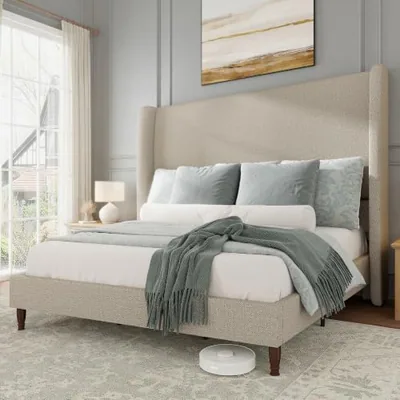
A headboard that rises most of the way to the ceiling draws the eye up. That works well in a room with a high ceiling and plain walls. It can feel heavy under a low ceiling or a sloped attic wall. We make wingback headboards on 92 frames, and those wrap outward as well as upward. If your bed sits between two windows, a wingback can cross into the window trim. That is not a flaw, but it is a look you want to choose on purpose, not discover after the boxes are open.
| Headboard height | What it covers | Frames | Fabrics in the band |
|---|---|---|---|
| 40″ to 52″ | Below the window sill | 36 | Velvet, Corduroy |
| 52″ to 60″ | Shoulder of a standing adult | 16 | Velvet |
| 60″ to 70″ | Eye level and above | 23 | Velvet, Faux fur |
The right height depends on the mattress thickness too. A deep pillowtop adds several inches and can bury a short headboard so only a sliver shows. We design our platform beds to keep the headboard panel well above the mattress surface, even with a thick topper. But if you already own a mattress that sits unusually tall, measure from the floor to the top of the mattress and then add the headboard height from the page. If the number lands within a few inches of your ceiling, you might want a lower headboard or a room with more clearance.
We publish the height for a reason. It lets you tape a line on the wall and live with it for a day. You will know quickly whether the proportion feels right. Some of our tallest headboards top out near eight feet. They are meant for bedrooms with generous ceiling height, and we say so on the page. If your wall is short or broken by a window, a headboard in the mid-range often does the job without fighting the architecture. The frame should anchor the room, not compete with it.
Velvet, linen, faux fur, boucle, corduroy
Velvet changes the light in a room. It drinks it in at one angle and gives it back at another, and that is the first thing you notice after you fit the frame. We test every velvet we specify for rub count and pile mark, because a headboard you lean against every night should not show a permanent shadow where your shoulders rest. A velvet bed belongs in a room with soft bedside lamps and a rug that catches the footfall. It is not the right choice for a child who draws on furniture or a dog that sleeps against the base.
Linen breathes and it wrinkles, and that is why we keep it. It is the most honest fabric we offer. A linen headboard looks softer after a year than it did on day one, and the creases tell you where the pillows have been. It works in a room that gets morning light and in a house where the heating runs dry. It is not a fabric that hides a spill, so we keep it to the headboard and not the base in most of our frames.
| Fabric | Frames and sofas | How it feels and wears | Care |
|---|---|---|---|
| Velvet | 55 | Deep pile that shows a hand mark and hides a seam, brushes one way. | Vacuum with the nap, blot spills, keep it out of direct sun. |
| Linen | 19 | Matte weave with visible slub, cool to the touch, creases at the corners. | Vacuum, spot clean with water only, it will show a water ring if soaked. |
| Faux fur | 13 | Long pile, warmest to sit against, sheds a little in the first weeks. | Shake and brush, never heat-dry a cover. |
| Boucle | 3 | Looped yarn with a bumpy surface, hides wear, catches rings and claws. | Vacuum with a soft brush, no rubbing. |
| Corduroy | 16 | Ribbed cotton look, the ribs flatten where you sit most. | Brush along the rib, rotate cushions where you can. |
| Faux leather | 4 | Smooth coated surface, wipes clean, warms under a body. | Damp cloth, no solvents, keep sharp objects away. |
Faux fur, boucle and corduroy are all texture-first fabrics. Faux fur and boucle ask to be touched. A boucle headboard turns a plain wall into a feature without a coat of paint. Corduroy feels like a jacket you kept from college, and it brings that same warmth to a bedroom. It is the most forgiving fabric we use, because its rib hides a scuff. We sample each of these under a hand before we approve it, because a photograph does not tell you how it will feel when you lean back at eleven at night.
Storage under the mattress and inside the headboard
We think of storage in a bed by where it sits: under the mattress, in the base, and in the headboard. Each place works a little differently. We like it because it turns the part of a bed you never see into something useful.
A lift-up platform hides the most. It uses the whole footprint under the mattress, so it suits things you only need now and then, like spare linens or winter blankets. But the mattress stays on the platform when you open it, and the platform has to swing up somewhere. You are lifting the bedding with it, so it's not a quick-open drawer. If you want daily access to shoes or clothes, drawers are easier. They do need room to slide out. In a tight bedroom, a row of drawers against a wall can become something you work around instead of use.
| Piece | Size | Storage | Price |
|---|---|---|---|
| King Lift Up Storage Bed Frame, Linen Wingback Headboard, White | King | Lift-up platform | $339.99 |
| King Lift Up Storage Bed with Linen Wingback Headboard, White | King | Lift-up platform | $217.99 |
| Queen Storage Bed Frame, Corduroy 51.2 in Wingback Headboard, White | Queen | Storage headboard or drawers | $209.99 |
| King Storage Bed Frame, Corduroy 51.2 in Wingback Headboard, White | King | Storage headboard or drawers | $224.99 |
| King Bed Frame Velvet Upholstered with Lift-Up Storage, Gray | King | Lift-up platform | $319.99 |
| King Size Farmhouse Solid Wood Bed Frame with Storage Platform, Brown | King | Storage headboard or drawers | $249.99 |
| Twin Faux Fur Upholstered Daybed with Storage Drawers, Gray | Twin | Storage headboard or drawers | $239.99 |
| Twin Faux Fur Upholstered Daybed with Storage Drawers, Cream | Twin | Storage headboard or drawers | $239.99 |
Storage headboards work a little differently. They put shallow storage right where you sit, so a book, a phone, a glass of water can live within reach. We keep these compartments shallow, because anything deeper starts to crowd the sleeping space. They do not replace a dresser, and they are not for bulky items. We design them for the last few things you touch before sleep and the first things you reach for in the morning.
One note. Many of our storage frames are platform beds, so they can take a mattress without a box spring. We say so on each frame where that is true. If you already have a box spring you like, check that detail before you commit. A storage base can sit a little higher than an open frame, and that's fine for most sleepers. If you like a very low bed, though, the open space underneath may matter more. A drawer base is not the same as open clearance under the bed.
LED strips, reading lights and the charging station
A light on a bed frame is a small thing that changes a big piece of behavior. It lets one person read while the other sleeps, without a nightstand lamp spilling across the room. It tucks the switch within reach so you never have to lean out and fumble for a cord. And it keeps the floor clear. That is the whole point: the frame carries what the nightstand used to hold.
Our LED beds put a slim strip inside the headboard wing or along the platform rail, with a tap switch or a remote. The light is warm and low, not the cold white you get from a task lamp. You can read a paperback by it or find your water glass, and it is dim enough that it will not pull you fully awake at two in the morning. We shape the beam down and in, toward the pillow, away from your partner's eyes.
| Piece | Size | Light | Charging | Price |
|---|---|---|---|---|
| Full Corner Bed Frame with Bookcase & Drawers for Teens, Gray | Full | LED strip | No | $359.99 |
| Queen Bed Frame LED Lights Headboard, Velvet Upholstered, Gray | Queen | LED strip | No | $199.99 |
| King Bed Frame Faux-Fur Upholstered 60 in Tall Headboard, Gray | King | LED strip | Yes | $279.99 |
| Full Bed Frame LED Lights Headboard, Velvet Upholstered, Gray | Full | LED strip | No | $189.99 |
| Queen Bed Frame Faux-Fur Upholstered 60 in Tall Headboard, Gray | Queen | LED strip | Yes | $249.99 |
| Queen Bed Frame with 85 in Wide Velvet Upholstered Headboard, Gray | Queen | LED strip | No | $309.99 |
| Queen Bed Frame Farmhouse 51 in Headboard&Reading Lights, White | Queen | Reading lights | No | $249.99 |
| Full Bed Frame LED Lights Headboard, Velvet Upholstered, Black | Full | LED strip | No | $189.99 |
Some frames add a USB port or a wireless charging pad on the side rail or the headboard top. It is a simple idea: your phone lives where you sleep, not on a desk in another room. You plug in overnight and wake to a full battery. The port sits flush, so the cable does not snag when you shift the sheets. We do not pretend it is a smart home hub. It charges a phone and powers a reading light, and that is enough.
This is not for everyone. If your bedroom already has dimmable sconces on the wall and a charging drawer in the nightstand, an LED bed adds nothing you need. It earns its place in a room without built-in wiring or in a small apartment where every outlet counts. It also suits a child who wants a nightlight that feels part of the furniture, not a plastic plug-in on the baseboard. Pick it for the light and the charge, not for the gadgetry.
Solid wood against upholstery
We make both, and we sleep on both. A solid wood frame will outlast the mattress and probably the next one too. The grain is what you see, and the joinery is what holds it. There is no foam, no staple line, no fabric to pull tight. Lean a shoulder against a walnut headboard and it is cool, hard, and unmoving. Some people want that. Some people want to read in bed and feel a little give.
Upholstery is the opposite. It takes the edge off the room. A tall wingback headboard in velvet or boucle absorbs sound, softens the wall, and makes a bedroom feel less like a case for a bed and more like a room you want to stay in. We sit on every sample before we approve the fabric, because the way velvet catches light from a nightstand is not the same as the way linen does. The drawback is dust. A lint roller lives in the drawer of every upholstered bed we own, and we are fine with that.
| Solid wood frame | Upholstered frame | |
|---|---|---|
| Pieces we make | 77 | 106 |
| What you touch | Walnut, ash or oak, sealed | Velvet, linen, faux fur, boucle or corduroy over foam |
| Headboard | Often upholstered panel on a wood post | Full upholstered panel, 49″ to 100″ tall |
| Cleaning | Wipe | Vacuum with the nap, spot clean |
| Who it will not suit | Someone who wants to lean back and read | A house with a cat that scratches |
A solid wood bed does not hide. A scratch stays a scratch, and that is part of the point. Oak and ash take on a patina that a photograph will not capture. If you move house often, a wood frame is heavier and less forgiving of doorframes. Upholstered frames are lighter, and the fabric panels can be spot-cleaned. Neither is the wrong choice. The wrong choice is the one that looks right in a picture and feels wrong when you sit up in the dark.
We draw the headboard first and the room second. For a bedroom that is mostly a place to sleep, we lean toward upholstery. For a room that works as a study, a dressing room, or a place where children jump, solid wood earns its keep. The table below lays out the six things that matter most when you are holding a tape measure.
A child's bed, and the rule about bunks
A child picks a bed with their eyes, not with a tape measure, and that is how it should be. A cloud-shaped headboard or a house frame with a little roof makes the room feel like theirs. We keep the proportions smaller and the platform lower, so a five-year-old can climb in without a running start. The fabrics are the same velvet and linen we use on adult beds, because a kid's room gets just as much afternoon light and just as many sticky fingers.
The one place we draw a hard line is bunks. A bunk bed is a piece of sleeping equipment for two children, and every safety rule that follows starts from that fact. The top bunk is not a play structure. The guardrail is not optional. The ladder is not a toy. We build our bunk beds to hold still under a child who rolls, and we say plainly what age they are not for, because a fall from that height is not a scraped knee.
A bunk bed is a bed with the bottom of its mattress foundation more than 30 inches above the floor.
U.S. Consumer Product Safety Commission, Bunk Beds Business Guidance. Read 23 August 2026. Source
This rule seeks to prevent the risk of deaths and injuries of children from being trapped between an upper bunk and a wall, in openings below the guardrails, or in openings in the ends of bunk beds.
U.S. Consumer Product Safety Commission, Bunk Beds Business Guidance. Read 23 August 2026. Source
Bunk beds must have at least two upper bunk guardrails, with at least one rail on each side.
U.S. Consumer Product Safety Commission, Bunk Beds Business Guidance. Read 23 August 2026. Source
The tops of the guardrails must be no less than 5 inches above the top of the mattress.
U.S. Consumer Product Safety Commission, Bunk Beds Business Guidance. Read 23 August 2026. Source
Some kids share a room, some do not, and a corner bed with a bookcase built into the foot end turns a small floor plan into a reading nook without adding a single piece of furniture. A daybed with a trundle pulls out for a sleepover and tucks away into a sofa the next morning. A slide on a low loft makes Monday morning slightly less impossible, and it bolts off when they outgrow it. These are beds that change as the child changes, and we design them so the changing does not require a second mortgage.
The mattress you put on a kid's bed matters more than the frame. A firm surface supports a growing spine. A soft top layer feels inviting but should not let a small body sink. We build our platforms to take a standard twin or full mattress without a box spring, so you can put the budget into the mattress and let the frame be the fun part.
The bed is a tool for sleep, not a photograph
A bed frame has one job, and it happens with your eyes closed. If a frame draws attention to itself at two in the morning, it has already failed. We design tall headboards because a wall needs proportion, but the fabric we choose has to pass a quieter test first: does it stay pleasant to lean against when you are half asleep? Velvet is warm on a cold wall. Linen breathes. Faux fur asks nothing of you. None of them are right for every room, and we would rather you know that before you click.
We build platform beds that take a mattress without a box spring, and we say so on the pieces where it is true. What we cannot tell you is whether your back will agree. A platform feels firmer than a box spring, full stop. If you wake up stiff on a hotel mattress, a platform bed may not be your friend. If you sleep better on a floor than on a pillowtop, it probably will. The frame itself is neutral. Your spine is not.
The daily recommended hours of sleep you need changes as you age.
Centers for Disease Control and Prevention, About Sleep. Read 23 August 2026. Source
Adult 18–60 years 7 or more hours
Centers for Disease Control and Prevention, About Sleep. Read 23 August 2026. Source
The charging station on an LED bed is useful. The reading light is useful. Both are useless if the blue standby LED blinks at you in the dark. We try to place lights where they illuminate a page and not a pillow, but a room with blackout curtains will still punish a single point of light. Cover it with tape or choose a frame without electronics. A bed is a tool, and a tool should let you rest.
We sit on every sample before we approve a fabric. It is the least scientific test we run and the one we trust the most. A photograph can sell you a bed in three seconds. Sleep needs eight hours. We design for the second number.
The six numbers to write down
Before you open a browser, write down six numbers. The width and length of your mattress, in inches. The width of the wall where the headboard will stand. The height of that wall from the floor to the lowest windowsill, light fixture, or picture rail. The distance from the foot of the bed to the nearest wall or dresser you will need to walk past. And the width of the narrowest doorway the frame has to pass through on its way to the bedroom.
These numbers settle most of the decisions that follow. A mattress size tells you the minimum frame footprint, but a wall measurement tells you what headboard height the room can actually hold. Our tallest headboard is 65″ and our shortest is 49.2″. The one you pick has to sit comfortably under a window or a sloped ceiling without crowding the trim. The bed in the photograph, for instance, has a headboard that reaches 65″, so the wall behind it needs to be clear of sills and vents that would break the line.
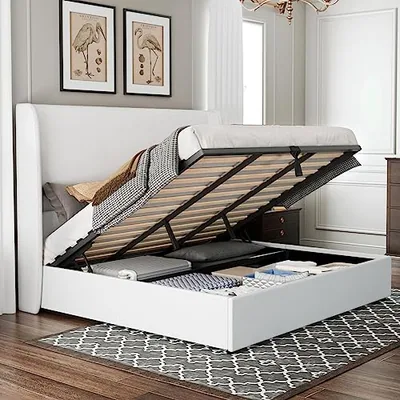
Door width is the number people forget and regret. A frame that arrives in a few pieces and assembles without tools, as many of ours do, still needs to fit through a bedroom door turned sideways. Measure the door, not the hallway, and write down the smaller of the two if you have a tight corner. The walkway number is just as practical. Leave at least twenty-four inches between the foot of the bed and the next surface, or you will shuffle sideways every morning.
Gathering the six numbers takes five minutes. They cost nothing and they save you the quiet frustration of a frame that fits the mattress but not the room. We build beds for the wall they will lean against, and those six figures let you see the whole picture before the first box arrives.
Sources we read for this piece
- U.S. Consumer Product Safety Commission, Bunk Beds Business Guidance, www.cpsc.gov/Business--Manufacturing/Business-Education/Business-Guidance/Bunk-Beds. Read 23 August 2026.
- Centers for Disease Control and Prevention, About Sleep, www.cdc.gov/sleep/about/index.html. Read 23 August 2026.